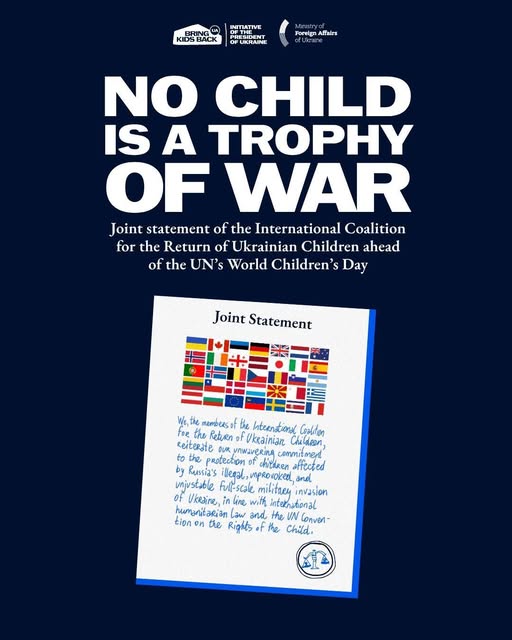
In Rome, a crowded room at the Ukrainian Embassy became a stage for some of the war’s most painful truths: children aged 14 to 18, accompanied by grandparents and relatives, spoke about being taken from Ukrainian-controlled areas and held in Russian-controlled zones. Thanks to Bring Kids Back Ukraine, a program created under President Zelenskyy to coordinate returns, several dozen youths have been repatriated to Ukrainian-controlled territory.
Their testimonies reveal a brutal interplay of propaganda, detention, deportation, and, in many cases, torture, aimed at eroding Ukrainian identity and loyalty. What the room carried beyond personal trauma was a stark, systemic pattern: re-education and Russification designed to reshape demographics in occupied zones or to train a new generation of potential soldiers. Eleonora Mongelli, vice president of the Italian Federation for Human Rights, cited estimates that as many as 1.6 million Ukrainian children remain under Russian control. Ukraine has recovered roughly 1,600 children so far, with each return mediated by third parties such as Qatar, South Africa, and the Vatican.
Ukrainian authorities have verified more than 19,500 abduction cases since Russia’s full-scale invasion began in early 2022, though the real number is almost certainly higher. Yale University’s Humanitarian Research Lab projects the deported children could be as high as 35,000 as of March 19, 2025. Russia’s Children’s Rights Commissioner Maria Lvova-Belova has claimed that Russia “accepted” hundreds of thousands of Ukrainian children between early 2022 and mid-2023.
Forced separation and filtration camps
The testimonies detail how “filtration camps” have operated as checkpoints to screen civilians and sever family ties. Civilians are interrogated, belongings are searched, and loyalty is assessed before movement between cities or across control lines. In many cases, minors were torn from their families; Liudmyla Siryk recounts how her grandson Oleksandr, severely wounded in Mariupol during shelling, was separated during the process and later located back in Ukraine by his grandmother. Veronika Vlasova, who was 13 when her village was surrounded in Kherson, described being held in a filtration camp, bullied for being Ukrainian, and pressured to claim loyalty to Russia. She was ultimately placed in an orphanage, spending two weeks in isolation before returning to Kyiv years later. The long-term effects are grave: psychological trauma, altered sense of identity, and a troubling ease with obedience that psychologists describe as a loss of free will.
Global response, accountability, and paths forward
Ukraine’s government, through Bring Kids Back Ukraine, continues to press for formal mediation and dialogue, including requests for the Holy See to act as a mediator with Russia. Iryna Vereshchuk, deputy head of President Zelenskyy’s office, indicated that Pope Francis’s late humanitarian initiative could become formalized with Vatican involvement, seeking a structured, negotiated framework for civilian returns and safeguards. The international response—ranging from third-country mediators to ongoing diplomacy with the Vatican and other partners—aims to increase safe repatriations, ensure medical and psychological support for rescued children, and address the broader humanitarian crisis. While the numbers reveal the scale of the challenge, survivors like Veronika, Oleksandr, and others underscore the urgent need for durable protections and accountability to prevent a repeat of these abuses.