You’ve read the brochures about Greenland as a cruise stop. But the real transformation waits not on a crowded deck, but in a wind-washed camp where the fjord breath becomes your daily rhythm. Seventy-two hours with no phone and no solid roof above your head seems brutal—until the mind quiets. Anika Krogh, Greenlandic founder of Nomad Greenland, puts it plainly: after day three, ‘something magical happens. People start to really be here.’ Studies cited by Krogh suggest stress hormones can decrease by up to forty percent when you slow down in this edge-of-the-world landscape. This is not a retreat carved from a hotel brochure; it’s a shakedown by nature, in tents pitched along Saqqaq’s shoreline or Kiattua’s narrow Nuuk Fjord flank, where electric blankets replace city heat and meals fuse caribou, arctic char, and market produce under a canvas roof.
The gateway is changing too. Greenland is becoming more reachable without surrendering its wild soul. Air Greenland now flies directly from Copenhagen, and United operates twice-weekly service to Newark, turning the journey into a practical, low-impact choice for European travelers who want to tread lightly and slowly. A different kind of itinerary unfolds here: you don’t chase a ticked-off checklist; you follow the rhythm of the sea, the ice, and the distant hum of mountains.
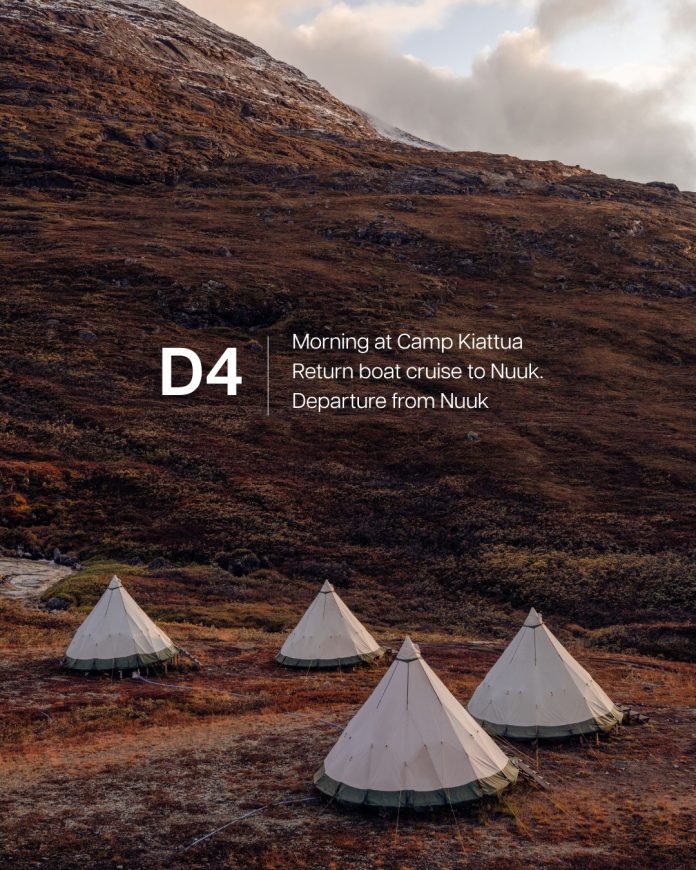
The Saqqaq Camp and Camps Kiattua prove that sustainable travel can coexist with comfort. Six tents perched on wooden platforms welcome you with sealskin pillows, warm showers, and a teepee-shaped dining tent where local dishes mingle with fresh produce from more forgiving climates. This is not roughing it for the sake of it; it’s a deliberate shift to an experience where nature’s terms prevail and your itinerary is dictated by the fjord’s tempo rather than a timetable.
Daily life centers on immersion: a rubber dinghy ride through glacier-green waters, close-up views of icebergs towering like natural sculptures, and hikes along caribou paths where the wind writes the day across your skin. The harbor is home to whales and calves that glide past with little fanfare, reminding visitors that Greenland’s real spectacle is often quiet and intimate, not broadcast from a ship’s loudspeakers.
Beyond the sensory drama, the Arctic offers a tangible mental reset. The combination of sparse connectivity, expansive skies, and slow daily routines works in concert with the body’s biology. The Greenland experience invites you to inhale deeply, wear the cold like a passport, and let stress dissolve where every breath becomes a boundary you choose to cross.
Travelers should plan for the June-to-September window when camps operate and flights connect via Copenhagen or Newark. Lodging emphasizes tented comfort with heat and privacy, not luxury hotels, aligning with a growing European appetite for sustainable, low-impact adventures that barely touch the tourist crowd. The payoff is a more intimate, more real encounter with a landscape that shapes you as much as you shape it. If you’re seeking a transformative Arctic escape that respects the land, this is your path.