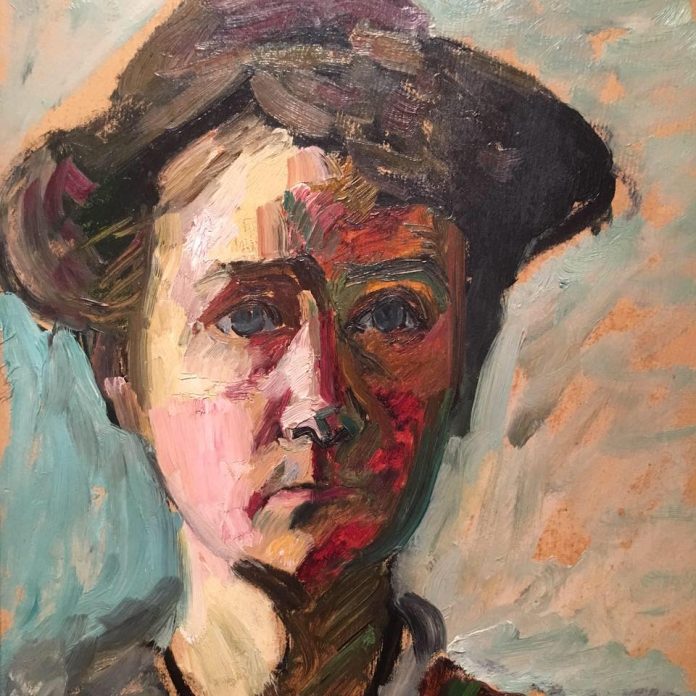
Guggenheim’s new survey drops a provocative claim: Gabriele Münter wasn’t only a painter, she was a keen observer who used a camera before a brush, and those photographs illuminate how she later shaped color, form, and space. The show Contours of a World reframes her as a photographer-first artist, challenging long-held narratives that center her in Kandinsky’s orbit. Fontanella, the Guggenheim curator, notes, „She picked up a camera before she even picked up a brush,” and the exhibition marks the first U.S. presentation of Münter’s photographs. The result is a fresh, documentary lens on a modernist pioneer.
Münter’s early experiments with framing, depth of field, and the interplay of light and shadow reveal a deliberate prefiguration of her later paintings. The display traces how her camera work informed spatial relationships and perspective—an approach that would translate into the way she builds scenes on canvas. Works such as Breakfast of the Birds (1934), where the subject turns away from the viewer, embody this interest in distance, proximity, and the shifting planes that structure a viewer’s sight, echoing the way she looked through the lens.
Among the photographs on view is Three Women, captured during the Emancipation Day Festival in Marshall, Texas, 1900. Münter herself wrote that she was snapping as if her body and soul depended on it, a reminder that she chronicled life not as background, but as vital witness. The camera becomes a diary of moments—racialized, intimate, historical—that later feed into a broader, more experimental painterly language.
Across her oeuvre, Münter is portrayed as a relentless observer of everyday life—pioneer in a moment when many artists sought fracturing and abstraction. Fontanella emphasizes that Münter’s insistence on depicting life in clear terms helped advance a more pluralist version of modernism. The show argues that her practice—looking at friends, rooms, and scaffolding on streets—offers a crucial counter-narrative to the era’s dominant theories.
This exhibition also functions as a curatorial corrective: the museum’s permanent collection includes only a single 1930s Münter painting, in a roster otherwise dominated by Kandinsky and other male peers. The show is described as a chance to acknowledge Münter’s radical, life-affirming approach and to widen the canon of modern art by foregrounding overlooked voices. As Fontanella puts it, Münter’s work rewards those who invest time; Contours of a World runs at the Guggenheim through April 26, 2026, inviting a rethinking of how modernism was made and who gets to tell its story.